



Why Neutral? Understanding Needle-Free Connector Fluid Displacement
Why Neutral? Understanding Needle-Free Connector Fluid Displacement
Why Neutral? Understanding Needle-Free Connector Fluid Displacement
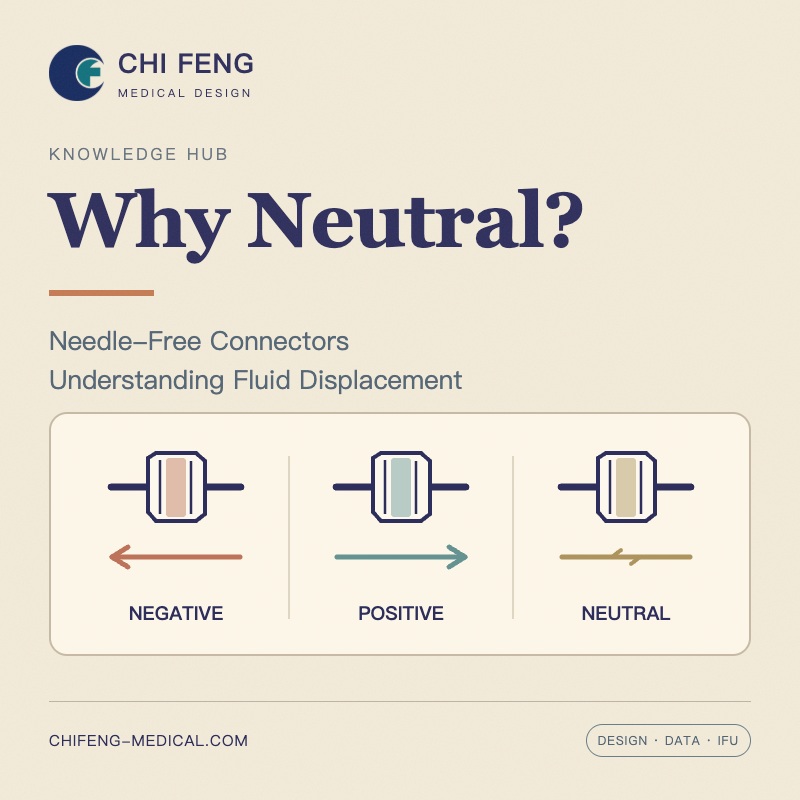
Why does neutral displacement matter in a needle-free connector?
Connecting or disconnecting a syringe can move fluid within a needle-free connector and its attached tubing. This is called fluid displacement. Understanding it helps procurement, product development and clinical teams ask clearer questions about connector selection.
Negative, positive and neutral: the basic difference
| Type | General design concept | What to verify |
|---|---|---|
| Negative displacement | Disconnection can draw fluid back toward the connector. | Measured displacement and the specified flushing and clamping sequence. |
| Positive displacement | Disconnection is designed to move a small volume toward the catheter. | Measured volume and the clamping timing in the instructions for use. |
| Neutral displacement | The design aims to limit fluid movement during connection and disconnection. | Results for both phases, with the test conditions identified. |
Displacement describes fluid movement and volume; pressure is a different physical quantity. Check what a specification actually measures.[1]
Does neutral mean zero reflux?
The label alone cannot establish that. A 2020 in vitro study by Gibson and Primeaux evaluated 13 connectors and found varying fluid displacement during connection or disconnection.[1] A separate 2016 laboratory study also found differences in reflux between the devices tested.[2]
These were studies of particular devices under specific conditions, not tests of CHI FENG Gen2. Their findings cannot establish clinical infection, thrombosis or occlusion outcomes for a different product.
Four questions to ask before selecting a connector
- Which phase was tested? Ask about both connection and disconnection.
- What are the conditions? Request units, direction of movement, tubing configuration and method.
- What does the IFU require? Confirm the flushing, clamping and disconnection sequence for that model.
- How will the system fit together? Assess the intended syringe, catheter and tubing connections.
Do not omit a clamping step solely because a connector is described as neutral. Follow its instructions for use and your institution's protocol.[1]
Watch the animation: Why Neutral?
Our hand-drawn animation introduces fluid displacement in needle-free connectors.
Clarification: Neutral is a design classification, not proof that every model produces zero reflux or permits omission of clamping. Follow the specific model’s instructions for use and institutional protocols for flushing, clamping and disconnection. Safety statements in the video do not establish that CHI FENG Gen2 reduces infection, thrombosis or occlusion.
Discuss your connector project with CHI FENG
Explore our Gen2 needle-free connector information, or contact us about model selection, component design and OEM/ODM requirements. Performance evaluations should use current technical documentation for the relevant model.
Email: pei@e-elect.com.tw
References
- Gibson SM, Primeaux J. Do Needleless Connector Manufacturer Claims on Bidirectional Flow and Reflux Equate to In Vitro Quantification of Fluid Movement? Journal of the Association for Vascular Access. 2020;25(4):28–36. doi:10.2309/JAVA-D-20-00031.
- Elli S, Abbruzzese C, Cannizzo L, Lucchini A. In Vitro Evaluation of Fluid Reflux after Flushing Different Types of Needleless Connectors. The Journal of Vascular Access. 2016;17(5). doi:10.5301/jva.5000583.
For general education and product-selection discussion. Follow the product IFU and institutional protocols. Published findings are not CHI FENG product test results or clinical performance claims.